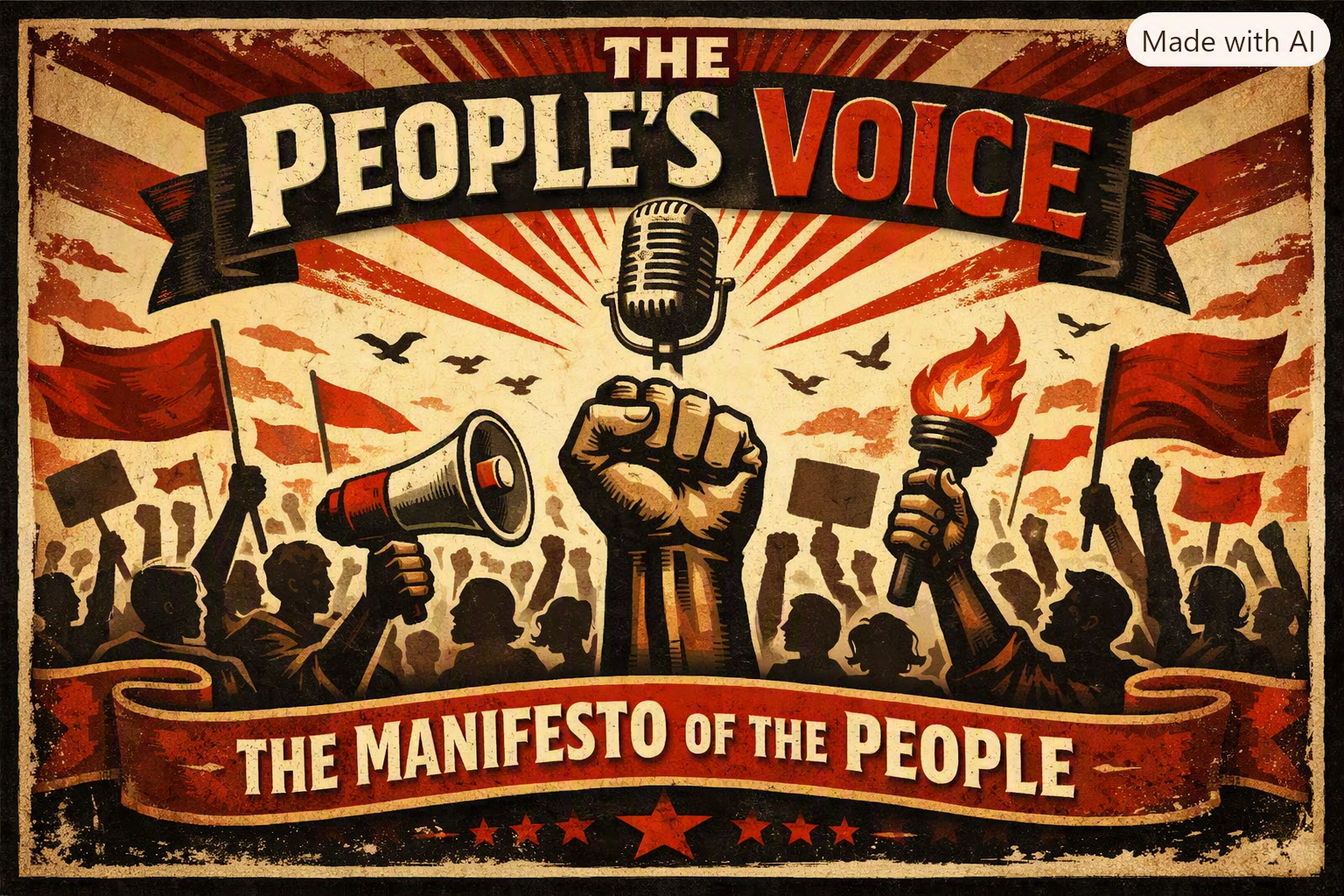
A manifesto serves as a powerful public declaration that articulates the fundamental beliefs, aspirations, and goals of an individual, organization, or political party with utmost clarity and conviction. It is not merely a document; it is a call to arms for every believer in progressive change, a charter that lays down the ideas that fuel movements and inspire collective evolution.
Purpose and Impact
1. Declare Intentions: A manifesto distills complex views into accessible language, making them understandable to the masses. It provides clarity amidst the noise of societal issues that can often feel overwhelming.
2. Call to Action: It acts as a rallying point, urging individuals to unite in support of a renewed movement aimed at transformative change. It ignites passion and encourages action, creating a sense of urgency that can mobilize entire communities.
3. Challenge the Status Quo: A manifesto boldly rejects outmoded ideas and practices, inviting society to envision an innovative future devoid of established limitations. This forward-thinking approach paves the way for a new era defined by enlightened perspectives.
Common Types of Manifestos
✊ Political:Typically issued by political parties or candidates during electoral cycles, these manifestos outline proposed policies and promises, setting the stage for public debate.
✊ Artistic and Literary: Creative movements, such as Futurism or Surrealism, issue manifestos to transcend previous artistic constraints, defining a fresh style that revitalizes cultural expression.
✊ Personal: On an individual level, these manifestos serve as guiding principles for personal growth, reflecting one’s life choices, values, and objectives.
Key Elements of a Manifesto
✊ Critique: Manifestos offer a thorough analysis of existing societal flaws, shining a light on what is fundamentally wrong and fostering an environment ripe for feedback and discussion.
✊ Vision: They provide a compelling glimpse of a better alternative, spearheading an inspiring narrative that encourages people to dream bigger and reach for what seems ultimately achievable.
✊ Action Plan: The best manifestos lay out a detailed roadmap, outlining the specific steps needed to achieve the articulated goals, providing a clear path toward transformation.
Every manifesto carries the weight of responsibility, representing the convergence of diverse ideologies, purposes, and aspirations rather than simply echoing the voice of a singular individual.
The Vision of a Decentralized Collective Society
At the core of various progressive philosophies, including anarchism and horizontalism, lies an ambitious and transformative vision for a society built on decentralization and collective empowerment. This radical approach seeks to dismantle traditional hierarchies, shifting authority from a privileged minority to the hands of the populace as a whole. When a deeply conscious, critically aware society collectively chooses to reject the concept of leadership structures, the very essence of governance experiences a profound transformation. It transcends mere political turnover, advocating for a reimagining and restructuring of societal functions from the ground up.
Mechanisms of Decentralized Collective Power
✊ Horizontal Organization: Within truly egalitarian frameworks, the age-old concept of top-down command structures becomes obsolete. Communities can thrive through decentralized assemblies, neighborhood councils, and direct democratic methods that promote collaborative decision-making. This ensures that no individual holds unchecked power, fostering a culture grounded in shared responsibility and mutual respect.
✊ Imperative Mandates and Rotation: Should representatives or delegates be necessary for coordination, they remain beholden exclusively to the directives of the community. Acting merely as spokespeople, they are stripped of decision-making independence. The principle of rotation becomes crucial; representatives are frequently reassigned, or they can be recalled at a moment’s notice, ensuring that power remains fluid and that no individual or group can monopolize control.
✊ Collective Management of Resources: Aiming to minimize individual dependency—which can inadvertently lead to concentrated power—crucial resources, infrastructure, and production are managed through networks of mutual aid and collective ownership. This collaborative methodology enhances solidarity and assures that the community members enjoy equal access to the essentials necessary for a fulfilling standard of living.
Historical Examples of Non-Hierarchical Systems: A Wealth of Lessons
✊ Revolutionary Catalonia (1936–1939): A vivid illustration of democracy in motion emerged during the tumult of the Spanish Civil War. In this period famously known as Revolutionary Catalonia, anarcho-syndicalist collectives, primarily comprised of workers, seized and effectively managed significant economic sectors—including factories and public services—without a centralized authority. The horizontal assembly structure enabled collective management of both production and defense, showcasing an inspiring testament to the efficacy and sustainability of such systems, despite being ultimately suppressed by external forces.
✊ The Zapatista Autonomous Municipalities (MAREZ): Since 1994 in Chiapas, Mexico, communities have adopted an inspiring governance model rooted in “governing by obeying.” In this empowering structure, authority rests within local assemblies, where administrative roles rotate frequently among citizens. This practice prevents the monopolization of power and cultivates equality and collective decision-making, illustrating a successful application of decentralized governance principles.
The Main Practical Challenges and More Lessons to Uncover
Coordination at Scale: While the principles of direct collective decision-making often work effectively at local levels, they pose challenges when it comes to managing extensive infrastructure, telecommunications, and transport networks without centralized leadership. This necessitates the development of sophisticated federation networks capable of coordinating diverse communities while maintaining decentralized governance.
✊ External Defense: A decentralized society faces critical challenges regarding defense against outside threats. Hierarchical states and counter-revolutionary forces wield concentrated military power, which presents significant obstacles to a society relying solely on decentralized organizations and cooperation for security.
The overarching vision encapsulates a pivotal premise: not merely achieving governmental transformation, but rather reclaiming the full spectrum of the human experience and existence. Access to fundamental needs—be it food, shelter, healthcare, the fruits of collective labor, or the inherent freedom to self-determine one’s destiny—should be recognized as an inalienable right, intrinsic to all individuals by virtue of being human, rather than a privilege doled out by an authoritative elite.
When a revolutionary movement shifts its focus from merely dismantling political structures to reclaiming essential aspects of daily life, it embarks on what can be identified as a social revolution or expropriation.
Reclaiming the Essentials of Existence
✊ Direct Access: In a transformed societal model, communities assume direct control over, and manage, land, housing, factories, and natural resources. This shift transitions these elements from mere commodities owned by a few to shared infrastructures designed to promote the well-being of all citizens.
✊ Production for Need, Not Profit: The economic framework undergoes a fundamental transformation, redirecting its focus from generating profit for an elite minority to fulfilling the material and cultural needs of all societal members. Here, the priority lies in meeting human necessities over monetary gain.
✊ Abolition of Artificial Scarcity: By employing modern technologies and resources, the objective becomes eliminating the imposition of deprivation, ensuring that everyone’s basic survival needs are met. This security empowers individuals to thrive, enabling them to lead fulfilling lives, liberated from the constraints of artificial scarcity perpetuated by existing socio-economic systems.
This Manifesto stands as a crucial reminder: to assume that a populace capable of overthrowing an oppressive regime somehow lacks the intelligence, coordination, or ingenuity to construct a more just and equitable society independently constitutes a profound misjudgment. Throughout history, emphasis often falls on charismatic leaders while neglecting the immense capacity of ordinary individuals for self-organization, adaptability, and collective intelligence. When the stakes are elevated and the drive to reclaim their destinies is unambiguous, communities have demonstrated their ability to unite and effectuate remarkable change.
As these communities garner support from their protectors—the police, military, and others who have historically served the interests of the elite—the pivotal question arises: Will these forces relinquish control and utilize their authority to reshape the conditions for the very people they once served? The implications of this question are both profound and far-reaching, illuminating the transformative potential of solidarity and mutual empowerment in the quest for a genuinely liberated society. It is this clarion call that unites individuals under the banner of a common vision, promising a brighter and more equitable future for generations to come.
 The People's Voice